Warning: Undefined variable $composer_id in /var/www/megapower.co/html/wp-content/themes/Twenty-Twenty-Four-Child/functions.php on line 918 Fantasiestucke Op. 73 arr. Bassoon and Piano – The Music Realm
Robert Schumann was a German composer, pianist, and influential music critic of the Romantic era, born on June 8, 1810, in Zwickau, Saxony, Germany. He passed away on July 29, 1856, in Endenich, near Bonn, Prussia, Germany. Schumann is renowned particularly for his piano music, songs (lieder), and orchestral music. Many of his best-known piano pieces were written for his wife, the pianist Clara Schumann.
Schumann’s early years were marked by his father’s influence, who was a bookseller and publisher. He began his musical education at the age of six, studying the piano. In 1827, he came under the musical influence of Austrian composer Franz Schubert and the literary influence of German poet Jean Paul Richter. In the same year, he composed some songs.
Despite initially studying law at the University of Leipzig, Schumann’s passion for music prevailed. He studied the piano seriously with Friedrich Wieck, Clara’s father, and eventually married Clara despite Wieck’s opposition2. Schumann’s early works were mainly piano pieces, including the large-scale “Carnaval” (1834–1835). He co-founded the “Neue Zeitschrift für Musik” (New Musical Journal) in 1834 and edited it for ten years, contributing significantly to music criticism.
His compositions include the “Piano Concerto in A Minor, Op. 54,” “Symphony No. 1 in B-flat Major,” and song cycles such as “Frauenliebe und -leben” and “Dichterliebe.” Schumann turned to orchestral music in 1841, chamber music and choral works in the following years, and his wife Clara premiered many of his works, including the Piano Concerto.
Schumann’s life was troubled by mental health issues, which led to his attempted suicide in 1854 and subsequent confinement in a sanatorium, where he died two years later. His legacy remains significant, as he was one of the most important Romantic composers and a highly regarded music critic, whose deeply personal music reflects the nature of Romanticism.
About Fantasiestucke Op 73 Bassoon Edition
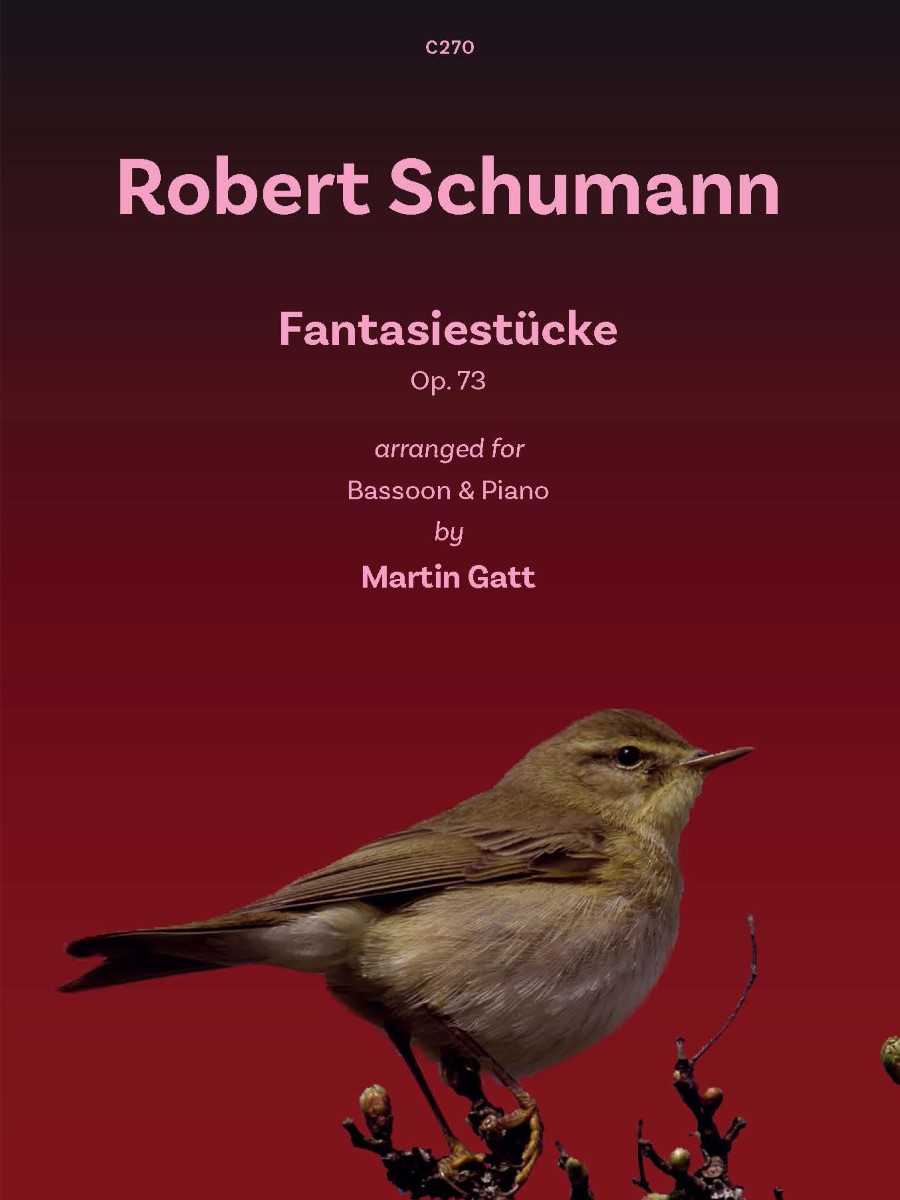
Schumann's famous Fantasiestucke Op. 73 in this edition has been arranged for bassoon by Martin Gatt, ex-LPO, LSO, ECO,…
About Fantasiestucke Op 73 Bassoon Edition
Schumann’s famous Fantasiestucke Op. 73 in this edition has been arranged for bassoon by Martin Gatt, ex-LPO, LSO, ECO, and Professor of Bassoon at the Guildhall School of Music and Drama for 20 years.
Originally written for clarinet and piano, Robert Schumann’s Fantasiestücke Op. 73 is a romantic gem comprising three expressive movements. When arranged for bassoon, it reveals a rich, earthy lyricism that feels both grounded and poetic—an inspired pairing given the bassoon’s vocal, sonorous character.
Movement I: Zart und mit Ausdruck (Tender and with Expression) In this opening piece, the bassoon lends a mellow warmth to Schumann’s song-like phrases. The lyrical lines, floating over a gently undulating piano accompaniment, evoke wistful reflection. With its wide dynamic range, the bassoon adds an understated gravitas, transforming the clarinet’s sprightly elegance into a deeper, more introspective voice.
Movement II: Lebhaft, leicht (Lively, light) This dance-like movement sparkles with rhythmic vitality. The bassoon’s agility comes to the fore, bouncing through playful staccatos and syncopations. It channels Schumann’s effervescent energy with a touch of whimsy—think spirited conversation between friends, punctuated with laughter and light-hearted jabs.
Movement III: Rasch und mit Feuer (Quick and with fire) The finale bursts with passion. The bassoon becomes a dramatic storyteller, racing through bold arpeggios and urgent melodic sweeps. Its darker timbre amplifies the movement’s emotional depth, infusing Schumann’s fiery climax with a touch of melancholy beneath the storm.