Warning: Undefined variable $composer_id in /var/www/megapower.co/html/wp-content/themes/Twenty-Twenty-Four-Child/functions.php on line 918 Nessun Dorma from Turandot – The Music Realm
Giacomo Puccini was an Italian composer born on December 22, 1858, in Lucca, Tuscany, Italy. He is widely regarded as one of the greatest exponents of operatic realism and is known for bringing the history of Italian opera to a close with his works. Puccini’s most famous operas include “La Bohème” (1896), “Tosca” (1900), “Madama Butterfly” (1904), and “Turandot” (1924), which was left incomplete at his death. His music is celebrated for its melodic richness and dramatic depth.
Puccini came from a family with a long tradition of music; he was the sixth of nine children of Michele Puccini and Albina Magi. His family had been the musical directors of the Cathedral of San Martino in Lucca for two centuries. After the death of his father, the municipality of Lucca supported the family and reserved the position of cathedral organist for Giacomo until he came of age. He first studied music with his father’s former pupils and played the organ in local churches.
A pivotal moment in Puccini’s life was witnessing a performance of Giuseppe Verdi’s “Aida” in 1876, which convinced him that his true calling was opera. He later attended the Milan Conservatory, where he studied under Antonio Bazzini and Amilcare Ponchielli. His graduation composition, “Capriccio sinfonico,” garnered attention in Milan’s musical circles.
Puccini’s career spanned the late Romantic period into the early modern era of opera. His works are characterized by their emotional intensity, intricate vocal writing, and incorporation of verismo elements—a style focused on realism and everyday subjects.
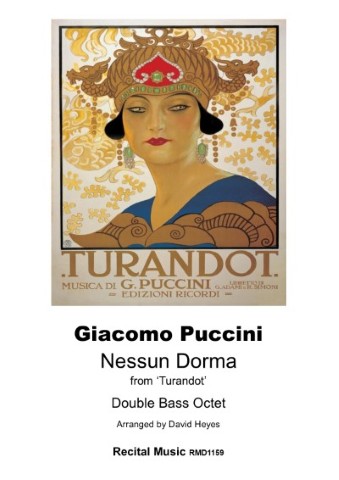
Nessun Dorma is one of the world’s best loved opera arias which has been performed by the greatest tenors of the last hundred years. Arranged…
Nessun Dorma is one of the world’s best loved opera arias which has been performed by the greatest tenors of the last hundred years. Arranged by David Heyes, it has much dramatic potential for the double bass octet with the soaring melody shared between basses 1 and 2.
A rich palette of tone colours can be explored, demonstrating the lyrical and cantabile possibilities of the double bass octet, creating an orchestral palette of accompaniment against which the soloists can ‘belt out a good tune.’ This has been popular in performance with musical challenges for each player.
Giacomo Puccini (1858-1924) was the most successful Italian opera composer of his generation and his operas are at the very heart of the international repertoire almost a century after his death
Turandot was Giacomo Puccini’s final opera and was left unfinished at the time of his death in 1924, completed two years later by Franco Alfano. It was premiered at La Scala in Milan on 25 April 1926 and has remained in the operatic repertoire to this day.
Who needs an overpaid tenor when eight basses can do the job!